
AI-staged property photographs: what Malta's real estate sector now has to disclose

An empty apartment can be furnished digitally in seconds. A tired kitchen can be replaced, damp can be painted out, and a mediocre view can be improved. The tools are cheap, fast and increasingly difficult to spot.
Since 2 August 2026, using them on property advertising without saying so has become a regulatory question rather than a matter of marketing taste.
What the law now requires
There is a simple rule across the European Union. If a business uses artificial intelligence to create or alter an image, and the result would pass for a real photograph, it has to tell the people who see it.
The rule is Article 50 of the EU AI Act, Regulation (EU) 2024/1689. It applies directly in Malta, as it does in every Member State. It does not turn on the size of the business, on how much was spent on the software, or on what the picture was for. It asks one question. Would an ordinary person take this image for an authentic record of something that exists?
For property advertising, that is an awkward question.
A "deep fake" does not need to involve a person
Article 50(4) requires deployers of AI systems that generate or manipulate image, audio or video content constituting a deep fake to disclose that the content has been artificially generated or manipulated.
Article 3(60) defines a deep fake as AI-generated or manipulated content which resembles existing persons, objects, places, entities or events and which would falsely appear to a person to be authentic or truthful.
Objects and places are expressly covered. The Commission's guidelines confirm that the definition reaches realistic depictions of objects, places, animals and events, and is not confined to digital replicas of real people. That is considerably wider than the popular understanding of the word.
An empty flat in Sliema, photographed and then digitally furnished, is still recognisably that flat. What the buyer sees is not what the camera recorded.
How much of this is actually happening
There are no Maltese figures, but there is industry data. Pedra, a Spanish supplier of AI staging and editing tools to estate agents, published a study in June 2026 covering more than 150,000 edits made through its platform between January 2024 and March 2026 in nine markets, among them Italy, Spain, France and Portugal. Malta is not one of them, the sample is a single vendor's own customers, and the vendor sells the product. The figures show direction of travel rather than market share. The direction is not in much doubt.
Virtual staging accounted for just over half of all edits, split almost evenly between furnishing empty rooms and renovation previews showing how a dated kitchen or bathroom might look after works. Renovation previews grew tenfold over the two years, and ambitious renovations outnumbered conservative ones three to one. Ordinary processing, meaning brightness, colour and perspective correction, made up around a fifth. Removing clutter and personal effects accounted for 15% and sky replacement for 3%. Overall use rose roughly ninefold in two years.
Two things follow. The category that most clearly needs a label, the image that alters the property itself, is also the fastest growing. And a fifth or so of what agents do to listing photographs is ordinary processing that needs no disclosure at all. Proportionate compliance means telling those two apart rather than labelling everything.
None of this is illegitimate in itself. Empty rooms photograph badly, physical staging is expensive, and a buyer looking at a bare shell often cannot judge whether a bedroom takes a double bed. The vendor's own summary of the change states the legal problem neatly: the industry has moved from showing the house to showing what the house could be. That is a fair commercial development. It becomes a legal one when the buyer cannot tell which of the two they are looking at.
Where virtual staging falls
Not every AI-assisted photograph is a deep fake. Two filters do most of the work.
The first is deceptive realism. Content that no viewer would take for a real photograph falls outside. The second is materiality. The manipulation has to be capable of affecting how the audience assesses what it is looking at.
The Commission published guidelines on Article 50 in July 2026, and its worked examples are useful here because several come from advertising. An AI-generated image of a product which misleads as to its actual appearance, characteristics or use, including by making it look better than it really is, is treated as a deep fake. A genuine product shown against an AI-generated background is not, provided the advertisement is not likely to mislead about the product itself. Routine colour correction, noise reduction and lighting adjustment sit outside the definition, because they do not change how the audience assesses authenticity.
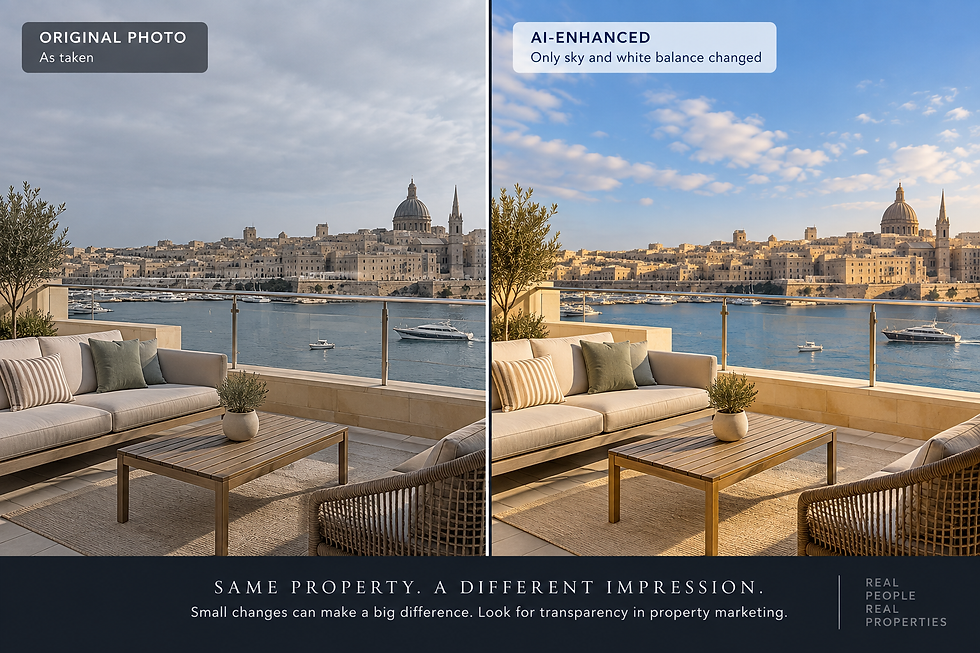
Applied to property listings, that produces a workable spectrum:
Ordinary processing. Exposure, white balance, sharpening, straightening and lens correction. Outside.
Sky replacement. Swapping a grey sky for a blue one changes the photograph but not the property, and on the materiality test it will usually sit with ordinary processing. It moves closer to the line where the sky is doing work, as with a sunset shot sold on the strength of the outlook.
Digital furnishing and decluttering. The walls, floor and dimensions are genuine; the sofa was never there. This is the contested middle. Whether it needs labelling turns on whether an ordinary viewer would read the image as a record of the property's present condition.
Altering the property itself. Replacing flooring, removing cracks or damp, swapping a kitchen, enlarging windows, deleting a neighbouring building or improving the view. Squarely within. These images change the very characteristics the buyer is paying for.
Agents should not expect help from the carve-out for artistic, creative, satirical or fictional works. The guidelines take the position that where content is both commercial and creative, its commercial character prevails. Property advertising will rarely qualify.
Disclosure that does the job
Article 50(5) requires the disclosure to be given in a clear and distinguishable manner, at the latest when the person is first exposed to the content, and consistently with accessibility requirements.
A general disclaimer at the foot of a long listing, reached well after the photographs, does not meet that description. The label belongs on or immediately beside the image. Something as simple as "Virtually staged using AI. The property is currently unfurnished" puts the viewer in an entirely different position.
Three practical points follow.
First, a small watermark in the corner of the image is not enough, and it is becoming the standard fudge. It is easy to miss on a phone, which is where most listings are now seen, and it disappears when a portal crops the image into a thumbnail or when the photograph is pushed out to social media. More importantly, a mark reading "AI" tells the viewer that something in the picture is artificial without telling them what. Someone looking at a photograph of a furnished, newly fitted kitchen cannot tell whether the furniture was added, the kitchen was added, or both. That is information supplied in an unclear and ambiguous manner, which is the territory Article 51D of the Consumer Affairs Act occupies. The label should say what was changed: "Furniture and soft furnishings added digitally. All fixtures and finishes are as photographed."
Second, machine-readable marking by the software provider does not discharge the agent's obligation. A prospective buyer should not need a detection tool to work out what they are looking at. The provider's duty under Article 50(2) and the deployer's duty under Article 50(4) are separate.
Third, the EU has published a voluntary code of practice on labelling AI-generated content, with standard icons, suggested wording and guidance on placement. Following it is optional, but it is the natural reference point if a regulator asks how a label was chosen.
Who carries the obligation
The duty falls on the deployer, meaning the person using the AI system in the course of a professional activity. A private owner touching up photographs of their own home falls outside. An agency, a developer or a marketing supplier does not.
Where an agency outsources photography and marketing, it should settle in the contract who applies the label and require confirmation in writing. The listing carries the agency's name, and consumer complaints will follow that name.
Consumer law runs alongside
The Unfair Commercial Practices Directive defines "product" to include immovable property, so marketing property to consumers is a business-to-consumer commercial practice.
In Malta, Article 51C of the Consumer Affairs Act, Chapter 378, treats a practice as misleading where it contains false information, or where its overall presentation deceives or is likely to deceive the average consumer about the main characteristics of the product, and causes or is likely to cause a transactional decision the consumer would not otherwise have taken. Article 51D deals with misleading omissions, including material information supplied in an unclear, ambiguous or untimely manner. Article 32B of the Commercial Code prohibits misleading advertising more generally.
Article 3(9) of the Directive lets Member States impose stricter or more prescriptive rules for immovable property than the Directive otherwise allows. Malta did not use that option. Property advertising is governed by the ordinary unfair commercial practices regime and nothing beyond it, which makes Part VIII of the Consumer Affairs Act the whole of the domestic consumer law picture.
The practical effect is that the analysis does not stop at the AI Act. An unlabelled staged photograph which brings buyers to a viewing, or to an offer, that they would not otherwise have made can be a misleading practice whether or not it meets the deep fake definition. An agent who says the image was only meant to show potential will struggle if the photograph reads as a record of what is there today.
The wasted viewing
Buyers do not browse listings at leisure. They take time off work, arrange for the children, drive across the island and give up a Saturday to see four or five properties. They shortlist from photographs because there is no other way to do it. When the flat that looked furnished and finished turns out to be a shell with a damp patch on the ceiling, the buyer has lost the afternoon and, more lastingly, any confidence in that agent and in the portal that carried the listing.
The law measures the harm the same way. A transactional decision is not limited to the decision to buy. In Trento Sviluppo (Case C-281/12), which concerned a leaflet advertising a laptop the supermarket did not have in stock, the Court of Justice held that the concept covers any decision directly related to the purchase decision, and in particular the decision to go to the shop. A listing works on a buyer in the same way. Deciding to attend a viewing is itself the transactional decision.
That disposes of the usual answer, which is that nobody was harmed because the buyer saw the property and walked away. The buyer was brought there by an image of something that did not exist. Walking away is the harm, not the cure.
The same analysis applies to lettings, and with more force. Rental viewings are booked in volume and decided in hours, often by people who need somewhere to live by the end of the month. A tenant who commits on the strength of a staged photograph has less time to discover the difference and far less room to walk away. Neither Article 50(4) nor Part VIII of the Consumer Affairs Act distinguishes between selling and letting. The agent is a trader either way.
Off-plan renders
An artist's impression of a building that does not yet exist is a different case. The deep fake definition targets content resembling existing objects, places and events, and a render clearly presented as an illustration is unlikely to be mistaken for a photograph of something real.
Consumer law still applies. A render which overstates dimensions, finishes, surroundings or views can mislead regardless of whether AI produced it.
Who enforces this in Malta, and what it costs
Legal Notice 226 of 2025, now S.L. 591.05, designates the Malta Digital Innovation Authority as Malta's market surveillance authority and single point of contact under the AI Act. Legal Notice 227 of 2025 gives the Information and Data Protection Commissioner a parallel role over certain high-risk systems involving sensitive processing. Those enforcement powers became exercisable on 2 August 2026.
The AI Act sets an EU ceiling for breaches of Article 50 at €15 million or 3% of total worldwide annual turnover. The domestic figure is the one to watch. Under S.L. 591.05, an operator faces an administrative penalty of up to €350,000 for each infringement, or up to 1% of total worldwide annual turnover for the preceding financial year if that is higher, together with a daily penalty of up to €12,000 for as long as the infringement continues.
None of this suggests that an agency which forgets to label one staged photograph will be fined into oblivion. Penalties have to be proportionate, and the MDIA has said it will support smaller operators. The point is that the exposure is real and is no longer theoretical.
Misleading property advertising engages a second regulator. The Director General of the Office for Consumer Affairs, which sits within the Malta Competition and Consumer Affairs Authority, can act on unfair commercial practices by administrative decision, including through administrative fines and public warning statements. Licensed intermediaries also answer to the Property Market Agency under Chapter 644, in force since 26 September 2024, which took over the licensing and supervision of real estate agents, property brokers, branch managers and property consultants. A single advertisement can therefore attract more than one regulator.
What agencies and developers should do now
Decide who within the business may use generative AI on listing images, and which tools they may use.
Separate photographs showing the property as it is from images showing how it could look, and label the second group on the image itself.
Do not use AI to conceal defects or change permanent features unless the image is unmistakably presented as an illustration.
Write the labelling obligation into contracts with photographers and external marketing suppliers.
Keep a record of which images were AI-generated or altered, by whom and using what. If a complaint lands, that record is the defence.
Train the people doing the work. Article 4 of the AI Act, as rewritten by the Digital Omnibus, now requires providers and deployers to take measures supporting the development of AI literacy among their staff.
There is a long tail to this. Malta identified truthful property advertising as a policy objective as far back as the 1991 White Paper on consumer rights, which promised measures to ensure that material promoting property sales would be "substantially truthful and relevant". No sector-specific rule of that kind was ever enacted. The AI Act has arrived at much the same place by a different route.
Virtual staging is a legitimate and often helpful tool. It lets a buyer understand how an empty room might work without anyone having to furnish it. The difficulty arises when possibility is presented as fact.
The working rule is short. If AI has materially changed what the buyer sees, say so, on the image, where they will see it first.
This article provides general information as at September 2026 and is not legal advice. The application of the AI Act and of consumer protection legislation depends on the circumstances of each case.

Comments